
Description
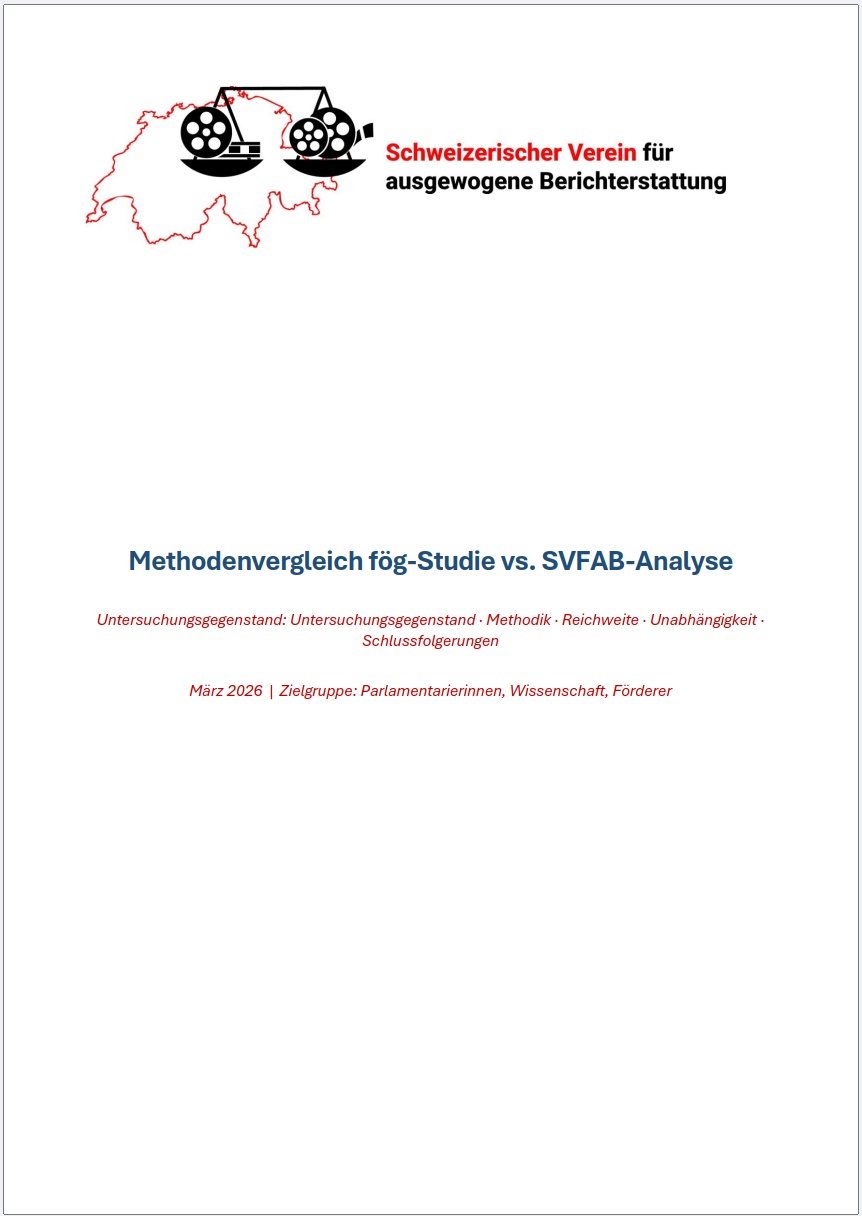
In February 2026, the fög (Research Centre for the Public Sphere and Society, University of Zurich) published a factsheet certifying the SRG’s political balance — just weeks before the popular vote on the SRG halving initiative. Since then, this study has been cited as scientific proof of SRG’s impartiality.
SVFAB has compared the methodology of both studies. The result: fög and SVFAB measure different things — and do not contradict each other. But only together do they provide a complete picture.
THE BLIND SPOT OF THE FÖG STUDY
The fög balance measurement examines exclusively popular votes — precisely those periods when editorial teams demonstrably pay particular attention to balance. The remaining 330 days of the year remain unexplored. Only a single dimension is measured: Do pro and contra of a proposal get roughly equal airtime?
The fög says so itself: «With the votes, only a very small part of overall coverage is examined. In a comprehensive study, the conclusion would likely be different.»
WHAT THE SVFAB ANALYSIS DOES DIFFERENTLY
SVFAB closes precisely this gap:
| fög | SVFAB | |
|---|---|---|
| Period | Voting phases only | 365 days/year, multiple years |
| Data volume | ~200–300 reports/medium | 25,000+ broadcasts (complete survey) |
| Survey type | Random sample | All broadcasts without gaps |
| Criteria | 1 dimension (tonality) | 15 dimensions (framing, word choice, expert selection, moderation behaviour, etc.) |
| Presenters | Not evaluable | Individually evaluable (for SRG-internal training purposes only) |
FOUR KEY FINDINGS OF THE COMPARISON
- Limited validity: fög measures balance only during popular votes — the only window in which editorial teams pay particular attention.
- Sample instead of complete survey: The fög quality measurement is based on a few dozen analysed broadcasts per format and year. SVFAB analyses all of them.
- No critical finding: The factsheet contains not a single critical finding regarding SRG and mentions no methodological limitations — unusual for a scientific document.
- Funding questions: The Reuters Institute, cooperation partner of fög, is co-funded by the Thomson Reuters Foundation and other media corporations. This structural conflict of interest is not mentioned in the factsheet.
THE COMBINED CONCLUSION
fög: SRG reports on popular votes in a balanced manner.
SVFAB: In everyday reporting, measurable bias patterns emerge on multiple levels — framing, word choice, selection of interviewees, moderation behaviour.
Both findings are true. Only together do they provide a complete picture of SRG coverage.
WHO THIS COMPARISON IS RELEVANT FOR
- Parliamentarians: Why is there no year-round quality control for CHF 1.2 billion in fees per year?
- Academia: SVFAB complements fög research and actively seeks methodological collaboration.
- Supporters: Independently funded, no ties to media corporations or parties.
Reviews
There are no reviews yet.